
Well Pump Replacement
A well pump retires after a long career — typically 10 to 20 years of starting hundreds of times a week. Replacement done right isn't swapping like-for-like; it's the one chance in a decade to correct sizing, renew the drop pipe and wire, and set the whole string up for its next long run.
The Whole String Comes Up — So the Whole String Gets Judged
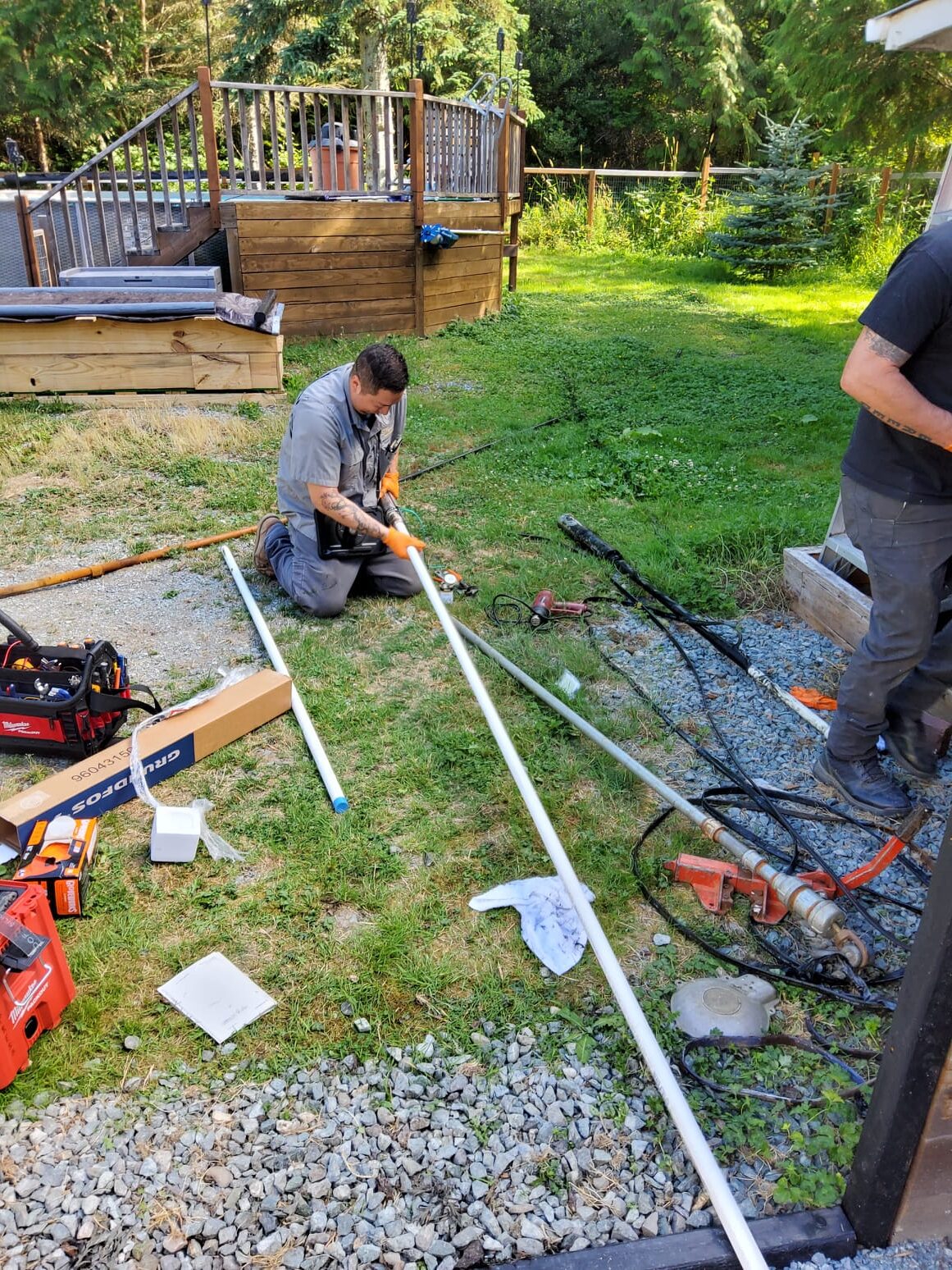
Here's what many homeowners don't realize about pump replacement: the pump is the cheap part of the labor. Pulling a submersible means lifting the entire string — pump, drop pipe, electrical wire, safety rope, check valves — up from wherever it hangs, sometimes a couple hundred feet down. Once it's on the surface, reinstalling old, brittle poly pipe or sun-baked wire splices under a brand-new pump is false economy at its purest: the labor to come back for a failed drop pipe in three years costs nearly as much as the whole job did today.
So our replacements judge everything that surfaces. Drop pipe with wear or age gets replaced while it's already out. Wire and splices are inspected and remade with proper waterproof connections. Check valves are renewed. And the new pump itself is selected against your well's actual documented depth and yield plus your household's real demand — because the decades since the original installation have often changed both the family and the fixtures the well serves. Rural properties from Everson to Sedro-Woolley get one shot at this per decade or two; we make it count.
What Careful Pump Setting Looks Like
Two pumps of identical quality can have wildly different lifespans depending on how they're set. Depth matters: too shallow risks drawdown exposure and dry-running; positioned wrong relative to well depth risks pulling sediment that grinds impellers down. Torque arrestors, cable guards, and proper support keep the pump from twisting and chafing its own wire against the casing with every start. Sanitation matters too — everything going down the well gets handled and disinfected properly, because you drink what comes back up. These aren't premium extras; they're the difference between an installation and merely a lowering.
Positioned against your well log's depth and static level — protected from both drawdown and bottom sediment.
Torque arrestor and cable protection so a decade of starts never chafes the insulation through.
Components disinfected, well chlorinated after work, and flushed — this is your drinking water source.
Pressure settings, tank charge, and amp draw all checked under load before we call it done.
Why LaVergne's?
What Pairs With a New Pump
A pump replacement touches the whole water system. These are the checks and upgrades that make the most sense while we're already there.
Pressure Tank Replacement
A tired tank will short-cycle a brand-new pump into early retirement. If yours is waterlogged or aged, replacing both protects the bigger investment.
Learn More →Well Pump Repair
Not certain the pump is truly done? Our diagnostic-first approach confirms it electrically before anything is pulled.
Learn More →Well Pump Installation
New wells and first-time systems get the full design treatment — pump, tank, controls, and plumbing to the house.
Learn More →Whole House Water Filtration
Replacement day is the perfect moment to address sediment, iron, or hardness the old pump had been fighting.
Learn More →Main Water Line Repair
The buried line from wellhead to house is the same vintage as your old pump. If it's suspect, now is the time to know.
Learn More →Financing & Pay Options
Wells rarely fail on payday. Financing options keep the correct fix affordable when the timing is bad.
Learn More →Pump on Its Last Legs? Replace It on Your Schedule.
A planned replacement beats an emergency one every time — in price, in parts selection, and in not spending a weekend without water.
How a Pump Announces Retirement
Pumps almost never die without notice — they decline, and the decline has a vocabulary. What separates a replacement signal from a repair signal is mostly age and pattern: an eight-year-old pump with a sudden electrical fault is a repair candidate, while a seventeen-year-old pump showing any of the signs below is spending your money on borrowed time. Knowing the difference lets you replace on your schedule instead of the pump's.
Runs Longer, Delivers Less
Steadily increasing run time to reach cutoff pressure means worn impellers moving less water per minute — mechanical aging, not a part failure.
Sand or Grit Appearing
Sediment in aerators and toilet tanks can mean the pump's wear parts are grinding — and that same grit is accelerating the wear causing it.
Rising Amp Draw
A motor pulling more current than its nameplate rating is laboring against internal wear. It's measurable, and it only trends one direction.
Past 15 With Symptoms
Any performance symptom on a pump past the 15-year mark deserves replacement math, not another patch — especially before winter.
Well Pump Replacement FAQs
Helpful answers about Well Pump Replacement from the experienced team at LaVergne's.
How long does a well pump replacement take?
Most residential replacements are a single-day job: pull the string in the morning, assess and renew components, set the new pump, chlorinate, and commission by afternoon. Deep sets, seized pipe, or wellhead complications can extend that, and we'll flag any of those risks when we scope the job. You're typically without water only during the working hours themselves.
Should I replace with the same horsepower pump?
Only if the original sizing was right — and it often wasn't, or the household has changed around it. Oversizing is the classic error: a too-powerful pump out-pumps the well's recovery rate and short-cycles constantly, wearing itself out fast. We size against your well log's yield and depth plus your actual fixture demand, which sometimes means a different answer than what's coming out of the ground.
What's a well log and do I need mine?
It's the driller's report filed when your well was constructed — depth, static water level, yield in gallons per minute, casing details. It's enormously useful for sizing, and Washington maintains these records publicly through the Department of Ecology's well log database, so even if your paperwork is long gone we can usually locate it. If no log exists, we can measure the essentials directly.
Do you replace the pipe and wire too, or just the pump?
We judge them on the surface, honestly. Sound modern drop pipe and healthy wire go back down — no point charging you for parts with life left. Aging poly, corroded galvanized drop pipe, or brittle wire gets replaced while the string is already pulled, because that's when it costs the least it will ever cost. You'll see the condition yourself before anything is decided.
Why is my water cloudy after the replacement?
Temporarily normal. Setting a pump stirs sediment that's been resting in the well for years, and post-work chlorination adds its own taste and cloudiness for a day or two. We'll give you flushing instructions — typically running outside spigots until clear. If cloudiness persists beyond a few days, call us; that's worth a look rather than waiting out.
Can the pump be replaced in bad weather or winter?
Yes — well work continues year-round, and frankly winter failures can't wait. Hard freezes make wellhead work slower and require care with exposed plumbing, but a household without water in January needs the pump set today, not in April. Our crews are equipped for it, and it's part of why rural families in the county keep our number handy.