
Pressure Tank Replacement
The pressure tank has one job: let your well pump rest. When the tank fails, the pump starts working for every glass of water — hundreds of extra starts a day — and pump motors die by the start, not by the hour. Replacing a failed tank is how you save the expensive component with the cheap one.

A Cushion of Air Is All That Stands Between Your Pump and Burnout
Inside a pressure tank, a rubber bladder or diaphragm separates a charge of compressed air from your water. Open a faucet and the air pushes stored water out — no pump needed. Only when the tank's reserve is drawn down does the pump kick on, refill it, and shut off for a proper rest. A healthy tank turns a hundred small water uses into a handful of long, easy pump cycles.
Then the bladder tears, or the air charge bleeds away, and the physics collapses. With no cushion, pressure crashes the instant a tap opens and the pump starts — for a toothbrush rinse, an ice maker cycle, a dog bowl. This is short-cycling, and it's the leading preventable killer of well pumps: each start surges the motor with several times its running current, and a waterlogged tank forces hundreds of them daily. Households from Custer to Conway have paid for premature pump replacements that were really tank failures wearing a disguise. The tank is a fraction of the pump's cost; replacing it on time is the best trade in well ownership.
A Tank Swap Done Properly Is a System Tune-Up
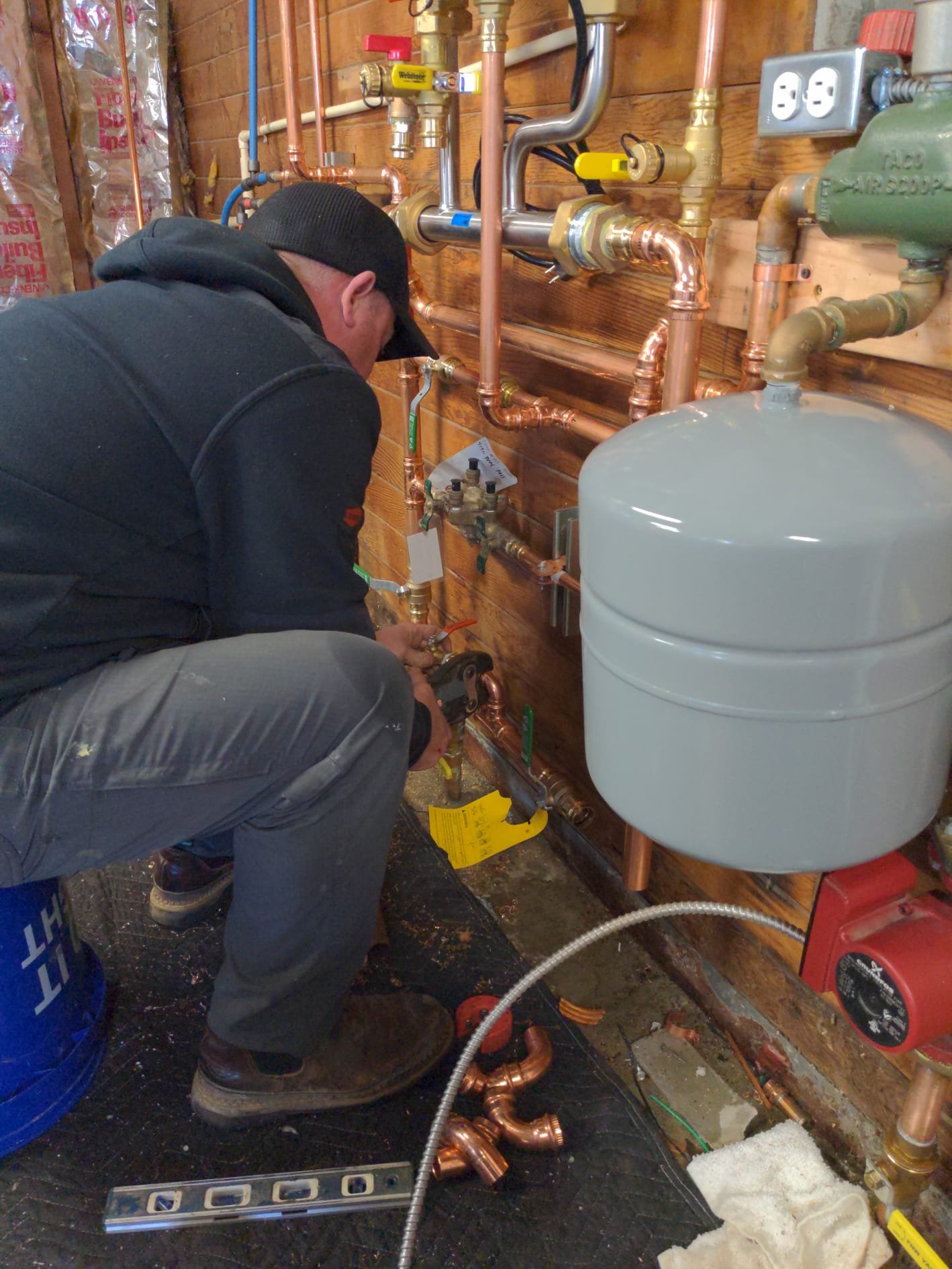
Replacing a pressure tank touches the nervous system of your whole water setup, which makes it the natural moment to get every adjacent detail right: the precharge set to two PSI below pump cut-in (the spec most rushed installs skip), the pressure switch inspected and calibrated, the relief valve and gauge renewed, and the tank tee plumbing rebuilt cleanly instead of reusing corroded fittings. Ten extra minutes of care here shows up as years of difference in how hard your pump works — and whether the new tank itself lasts.
Air charge set 2 PSI under cut-in and verified with the tank empty — the setting that makes the whole design work.
The pressure switch and gauge are cheap, aging, and adjacent — we test and replace them while the system is open.
New fittings, proper unions, and a layout that makes every future service faster and drier.
We run the system through full cycles and verify cut-in, cut-out, and drawdown before we leave.
Why LaVergne's?
Services Connected to Your Pressure Tank
The tank sits at the center of the well system — these are the services most often bundled with, or revealed by, a tank replacement.
Well Pump Repair
If short-cycling has been beating on your pump for months, a post-replacement checkup confirms whether the motor escaped unharmed.
Learn More →Well Pump Replacement
When the tank failure was caught too late, we replace pumps too — sized right and set right, with the new tank matched to it.
Learn More →Well Pump Installation
Designing a new system from scratch? Tank sizing is half the longevity equation, and it starts on day one.
Learn More →Whole House Water Filtration
Sediment and iron that scar bladders and clog switches can be filtered before they reach the tank at all.
Learn More →Leak Detection
A pump cycling with no water running isn't always the tank — sometimes it's a hidden leak. We can tell the two apart definitively.
Learn More →Water Heater Maintenance
Pressure problems stress water heaters too. Routine maintenance keeps the whole hot water side healthy.
Learn More →Hear Your Pump Clicking On Constantly?
Every unnecessary start is borrowed pump life. A tank diagnosis takes minutes — and the fix usually takes hours, not days.
Four Ways a Pressure Tank Announces It's Done
Tank failures are refreshingly easy to spot once you know the tells — no special equipment required for the first pass. There's even a 30-second home test: press the pin in the tank's air valve (like checking a tire). Air should come out. If water sprays out, the bladder is torn and the diagnosis is complete. Beyond that test, these four symptoms are the classic evidence.
Pump Starts at Every Tap
The signature symptom: any water use, however small, immediately clicks the pump on. A healthy tank should carry small draws alone.
Pulsing, Surging Pressure
Showers that throb between strong and weak track the pump slamming on and off with no air cushion to smooth delivery.
Water at the Air Valve
The tire-pin test above — water where air belongs means a ruptured bladder, full stop.
Tank Heavy or Sweating All Over
A waterlogged tank feels heavy top to bottom and condensates over its full height instead of just the lower portion.
Pressure Tank Replacement FAQs
Helpful answers about Pressure Tank Replacement from the experienced team at LaVergne's.
How long do pressure tanks last?
Quality bladder tanks typically serve 8 to 15 years, with water chemistry as the wild card — sediment and iron-heavy well water abrades bladders faster, and an incorrectly set air charge shortens life at any water quality. If your tank is past ten years and any symptom on this page sounds familiar, testing it costs almost nothing compared to what it's quietly doing to your pump.
Can a waterlogged tank be fixed by adding air?
Only if the bladder is intact and the charge simply bled down — in that case, recharging to spec is a legitimate fix and we're happy to do it. If the bladder is torn (water at the air valve is the giveaway), added air just dissolves into the water within days and the short-cycling returns. Recharging a ruptured tank is a treadmill, not a repair.
What size pressure tank should I get?
Generally the largest that space and budget reasonably allow, because tank drawdown directly buys pump rest. Sizing properly works from your pump's flow rate — the tank should hold enough usable water that the pump runs at least a minute or two per cycle rather than stuttering. Upsizing at replacement is cheap; it's the one component where "bigger than strictly necessary" is usually the smart engineering.
Why does the air charge setting matter so much?
Because it's the difference between the tank participating in the system or just being a steel ornament. Set too high, the tank delivers almost nothing before pressure crashes; too low, the bladder over-stretches and wears early. The spec — 2 PSI below the pump's cut-in pressure, set with the tank drained — is exactly the kind of detail that separates a proper installation from a drop-off.
My pressure switch also looks corroded — replace it too?
Almost always yes, and we include that judgment in every tank job. Switches are inexpensive, they age in the same conditions as the tank, and their contact points pit and stick over time — a stuck switch can burn out a pump even faster than a bad tank. Replacing a $30 part while the system is already open beats a separate service call by a mile.
Does a bigger tank change my water pressure?
No — that's a common mix-up worth untangling. Pressure is set by the switch (the cut-in/cut-out range); the tank's size sets how much water you get between pump cycles. A bigger tank makes delivery smoother and the pump's life longer, but if you want higher pressure itself, that's a switch adjustment conversation — one we can have at the same visit, including its tradeoffs.